How to Know If a Skincare Product Is Good for Your Skin
A skincare product is good for your skin when two things are true at once: the formula itself is well made — its key actives sit at a dose that can work, with nothing problematic in it — and that formula suits your skin type, concerns, preferences and the ingredients you want to avoid.
Most people only check one of those. A product can contain good ingredients and still be a poor choice for your skin — and a product with one debated ingredient can be exactly right for you. Scanning the list for a single scary-sounding name, or trusting a "clean" badge on the front of the pack, answers neither question. This guide gives you a small, repeatable method — two questions, six checks — for judging a product once you have its ingredient list in front of you.
This isn't about how to find or look up an ingredient list in the first place — for that step-by-step process, see our guide to how to check skincare ingredients before buying a product, or our comparison of the best skincare ingredient checker tools if you'd rather a tool do the lookup for you. This article picks up exactly where those leave off: you're holding the list, now what?
Two Questions, Not One: Ingredient Quality vs. Fit for Your Skin
Judging a skincare product means answering two separate questions: is this a good formula in general (ingredient quality), and is it a good choice for my skin in particular (profile fit)?
| Question | What it looks at | Can change from person to person? |
|---|---|---|
| Ingredient quality — is this a good product? | Whether the actives are useful, well supported and dosed to work; whether the formula is gentle and well built for its job | No — the same for everyone |
| Profile fit — is it right for me? | Your skin type, the concern you're treating, your sensitivities, your preferences, the ingredients you avoid | Yes — two people can get opposite answers |
Keeping the two apart is what makes the verdict useful. A rich, well-formulated moisturiser can score high on quality and still be the wrong pick for oily, acne-prone skin. A simple, fragrance-free cream with no headline actives can be an ordinary formula on paper and an excellent fit for reactive skin. Once you already know how to read and decode an INCI ingredient list, the six checks below answer both questions — the first three cover quality, the last three cover fit.
| Check | Question to Ask | Quick Signal |
|---|---|---|
| 1. Active position | Are the featured actives high enough in the list to be at a working dose? | Top half of the list = likely effective; last third = likely negligible |
| 2. Realistic context | Is a debated ingredient present at a meaningful dose, or a trace amount? | One ingredient rarely decides the verdict — check its role and position first |
| 3. The whole formula | Is the advertised "hero" ingredient backed by the rest of the list? | One good ingredient doesn't make a good product — read past the claim |
| 4. Red flags for you | Does it contain anything that specifically conflicts with your skin type or sensitivities? | Match the list against your own known reactions, not a generic list |
| 5. Actual fit | Do the actives address the concern you're actually trying to treat? | "Clean" ≠ "right for you" — check function, not just absence of concerns |
| 6. Your preferences | Does it respect the ingredients you avoid and the kind of formula you prefer? | A good product you'd rather avoid isn't a good product for you |
Part 1 — Is It a Good Product? (Ingredient Quality)
Ingredient quality is about the formula alone: whether it is built to do its job well, regardless of who uses it.
Check 1: Where the Key Actives Sit in the Ingredient List
The single fastest way to estimate whether a featured active is doing anything is to check its position in the ingredient list, since ingredients are listed in descending order of concentration¹.
This is a teaser, not the full picture: once an ingredient falls below roughly 1% concentration, brands can list it in any order they like, which is exactly the mechanism behind the 1% rule in skincare — we cover that threshold, and how to spot it precisely, in a dedicated guide. For now, the short version is: if the active a product is marketed on appears in the last third of a long list, treat that as a real yellow flag, not a dealbreaker on its own. A niacinamide serum with niacinamide at position 3 is a very different product from one with niacinamide at position 18, even if both say "with niacinamide" on the front.
Quality also means judging a product against what it's for. A moisturiser needs good hydrating, soothing and barrier-supporting ingredients — glycerin, ceramides, panthenol, plant oils — not the trendiest active of the year. A short, gentle formula that does its job well is a strength, not a weakness.
Check 2: One Debated Ingredient Doesn't Make a Product Bad
A single controversial ingredient almost never determines whether a product is good, because dose, position, and role in the formula matter far more than the ingredient's reputation alone.
Phenoxyethanol is a useful example: it's a synthetic preservative that shows up on plenty of "ingredients to avoid" lists, yet it's broadly well-tolerated and capped at 1% in the EU precisely because that concentration has been assessed as safe⁴. Standard preservatives and mild emulsifiers are part of almost every water-based cream — they keep it safe to use, and they don't make a formula worse. What does lower quality are real concerns: fragrance, essential oils, drying alcohol high in the list, or known irritants and sensitisers.
Check 3: Don't Judge a Product by One "Good" Ingredient
One desirable ingredient on the label tells you very little about the formula, because the rest of the list — dose, form and everything around it — decides how the product actually behaves on your skin.
Skincare marketing is built on this shortcut: "with niacinamide", "peptide complex", "ceramide complex", "vitamin C", "retinol", "hyaluronic acid". Each is a real, useful ingredient — and each can appear in a formula that is genuinely well built, or as a token amount surrounded by fragrance and drying alcohol. It's the mirror of Check 2: one good ingredient doesn't make a product good, any more than one debated ingredient makes it bad.
| Front-of-pack claim | What to check in the list |
|---|---|
| "With niacinamide" | Its position — it needs roughly 2% or more to do much, so look for it in the upper part of the list, not near the end |
| "Peptide complex" | Often present in tiny amounts, after the 1% line; check where the named peptides (e.g. Palmitoyl Tripeptide-1) sit, and what does the rest of the work |
| "Ceramide complex" | Whether the ceramides (Ceramide NP, AP, EOP) come with cholesterol and fatty acids, as in the skin's own barrier — and whether they're more than a trace |
| "Vitamin C" | The form: Ascorbic Acid is the most studied but unstable and needs a high dose at low pH; derivatives such as Ascorbyl Glucoside are gentler and more stable, with weaker evidence |
| "Retinol" | Not only the dose: retinol already challenges the skin, so fragrance or drying alcohol in the same formula makes it a harder product to tolerate |
| "Hyaluronic acid" | The exception that proves the rule: it works at very low levels, so a low position is fine — judge the formula around it instead |
That's why the useful question is never "does it contain X?" but "what does the whole list add up to?". It's also how Skanna reads a product: every recognised ingredient in the complete INCI list is weighed together, instead of searching for one name.
Part 2 — Is It Right for Your Skin? (Profile Fit)
Profile fit is about the meeting point between the formula and you: the same ingredient list can be a great match for one reader and a poor one for another.
Check 4: Red Flags for Your Specific Skin Type (Not Everyone's)
A red flag only means something in relation to a specific skin type, so the same ingredient list can be genuinely fine for one reader and genuinely risky for another.
| Skin Type / Concern | Watch For | Why It Matters Here |
|---|---|---|
| Sensitive / reactive | Parfum/Fragrance, individually listed allergens (Linalool, Limonene, Geraniol), Alcohol Denat. high in the list | Fragrance is the leading cause of cosmetic contact allergy² |
| Acne-prone / oily | Heavy occlusives high in the list (Petrolatum, Mineral Oil, heavy silicones) | Can worsen comedones specifically for this skin type |
| Dry / barrier-compromised | Alcohol Denat., strong exfoliating acids, sulfate surfactants | Strip lipids and worsen an already weak barrier |
| Pregnancy | Retinoids, high-dose Salicylic Acid, certain chemical UV filters | Precautionary avoidance per prenatal skincare guidance |
This guide is educational, not medical advice — check new skincare with your doctor if pregnant or nursing.
Notice that Alcohol Denat. appears as a concern for two different skin types and not at all for the others — which is exactly the point. Context matters too: high in a mattifying gel for oily skin, it's a deliberate design choice that keeps the product weightless; high in a product sold for dry or sensitive skin, it's a genuine mismatch. A generic "bad ingredients" list can't make this distinction; your own skin profile has to.
Check 5: Do the Actives Match What Your Skin Actually Needs?
A product can be perfectly "clean" by any popular definition and still be the wrong product, because the real question isn't whether an ingredient is controversial — it's whether the formula's actives address your actual concern.
A gentle, fragrance-free, silicone-free glycolic acid exfoliant might tick every "clean" box on a checklist and still be a poor fit for someone with a compromised, reactive barrier — while being an excellent fit for oily, dull, non-reactive skin. Conversely, a product with one debated preservative can be exactly right if its actives are dosed and matched correctly to your skin. This is why "is this ingredient safe?" is the wrong question to lead with — "does this formula do what my skin needs, at a dose that matters?" is the one that actually predicts results³.
Fit doesn't require a product to fix everything. A good hydrating cream for dry skin is a good choice even if it does nothing for dark spots — missing an active for one of your concerns lowers the fit a little; containing something that works against your skin lowers it a lot.
Check 6: Your Preferences and the Ingredients You Avoid
Your own preferences are part of fit: an ingredient you avoid, or a type of formula you prefer, can turn a well-made product into the wrong one for you.
- Ingredients you avoid. A known reaction to fragrance, an essential-oil sensitivity, a personal choice to skip silicones or mineral oil — if the product contains it, it isn't a good choice for you, however good its quality score.
- The kind of formula you prefer. Some people want minimalist formulas with short ingredient lists; others prefer fragrance-free or rich textures. A product that follows your preference fits better; one that clearly doesn't fits a little worse — it shouldn't be thrown out for that alone.
- Marketing claims vs. the list. "Fragrance-free" on the front doesn't always mean no Parfum or masking fragrance on the back. Check the ingredient list itself against your avoid list.
Real Example: Judging One Gel Serum on Both Questions
Here's the method applied to a realistic gel-serum ingredient list — the goal is the verdict, not a definition of each entry:
Aqua, Alcohol Denat., Niacinamide, Salicylic Acid, Glycerin, Panthenol, Phenoxyethanol, Sodium Hyaluronate, Parfum, Tocopherol, Disodium EDTA
Ingredient quality. Niacinamide sits at position 3 and Salicylic Acid at position 4 — both well within the top half of the list. Niacinamide at this position is very likely in the 3–5% range, comfortably within its clinically effective range for oil control and tone⁵, and Salicylic Acid this high is consistent with a genuine exfoliating dose rather than a token amount. Phenoxyethanol is a standard preservative and doesn't count against it. Alcohol Denat. at position 2 is a meaningful concentration, and Parfum is a real watch point. Verdict: a well-dosed, purposeful formula with one or two ingredients to watch — good quality, not exceptional.
Profile fit — it depends who's asking:
| Your profile | Fit | Why |
|---|---|---|
| Oily, acne-prone, not reactive | Good fit | Both actives target oil and breakouts; the alcohol keeps the gel weightless |
| Dry or barrier-compromised | Poor fit | Alcohol Denat. high in the list works against an already weak barrier |
| Sensitive / reactive, or avoids fragrance | Avoid | Parfum plus high alcohol: exactly the combination that triggers reactions |
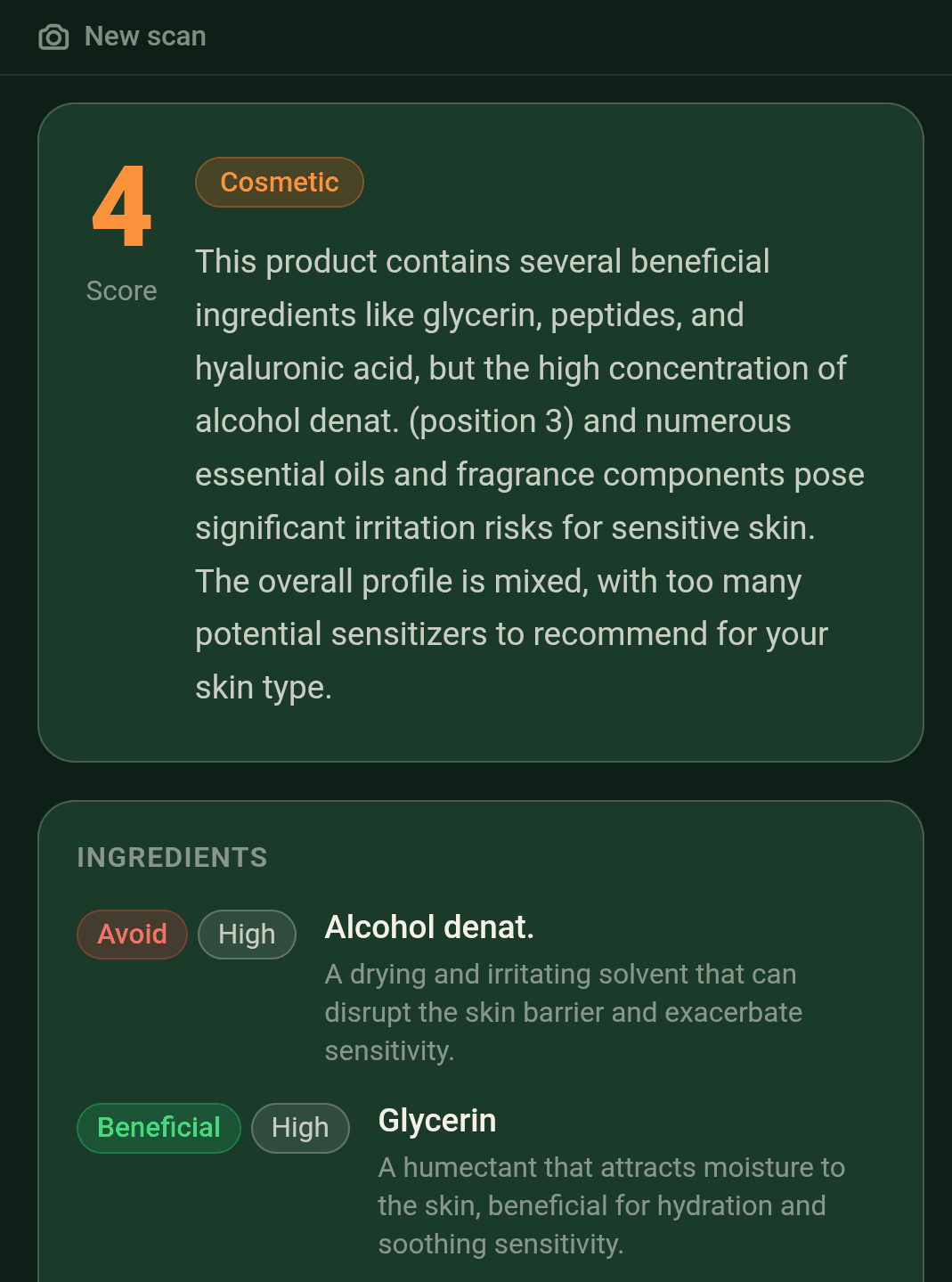
Verdict: same product, same list, same quality — three legitimately different answers on fit, depending entirely on whose skin is asking. That's why a single "good / bad" score can't tell you whether to buy it: you need both.

Check your own products in seconds
Scan a barcode or the ingredient list — Skanna tells you whether the formula is good and whether it suits your skin.
Try Skanna freeFree: 5 scans and 5 recommendations a week · Sign in with Google
Frequently Asked Questions
Can a good skincare product be wrong for my skin?
Yes — it happens all the time. Ingredient quality tells you whether a formula is well made; it says nothing about your skin type, your concerns or the ingredients you react to. A rich, well-formulated cream can clog acne-prone skin, and a high-quality exfoliant can irritate a damaged barrier. Judge both: is the formula good, and is it a good choice for you? A product only earns a place in your routine when the answer to both is yes.
How do I know if a skincare product suits my skin type?
Compare the ingredient list against three things: the red flags for your skin type (for example fragrance and drying alcohol for sensitive skin, heavy occlusives for acne-prone skin), the concern you want to treat (are the right actives present, high enough in the list?), and your personal avoid list. If the product passes all three, it's likely a good fit — then patch-test before using it on your whole face.
What ingredients should sensitive skin avoid?
Sensitive skin should watch for Parfum/Fragrance and the individually listed fragrance allergens (Linalool, Limonene, Geraniol, Citronellol, Eugenol), drying alcohols like Alcohol Denat. or Isopropyl Alcohol when they appear high in the list, formaldehyde-releasing preservatives (DMDM Hydantoin, Imidazolidinyl Urea), and high-strength chemical exfoliants. None of these are automatic disqualifiers — they're signals to check position and concentration before deciding, and to patch-test when in doubt.
Can two products have the same active ingredient but different effectiveness?
Yes — this happens constantly. Concentration, chemical form, formula pH, and supporting ingredients all shape how an active performs, so two products can both list "Vitamin C" or "Retinol" on the front and deliver very different results. Checking where the active sits in the ingredient list, and which specific form is used, tells you far more about real-world effectiveness than the front-of-pack claim alone.
Is a skincare product bad if it contains one controversial ingredient?
No, not by itself. What actually determines whether a product is good is the ingredient's dose, its position in the formula, and whether it conflicts with your specific skin type — not simply whether it appears on a "watch" list somewhere. A debated ingredient at a low, well-justified dose in a formula that otherwise suits your skin is rarely a reason to reject a product outright.
Sources / References
¹ EU Regulation (EC) No 1223/2009 on cosmetic products — Article 19 (labelling and INCI ordering requirements): eur-lex.europa.eu
² Cosmetic Ingredient Review (CIR) — safety assessments of fragrance materials and contact allergens: cir-safety.org
³ PubMed — peer-reviewed literature on cosmetic active ingredient efficacy and formulation: pubmed.ncbi.nlm.nih.gov
⁴ CosIng — EU Cosmetic Ingredients and Substances database, including Phenoxyethanol's EU concentration limit: ec.europa.eu/growth/tools-databases/cosing
⁵ PubChem (NIH) — molecular and functional data for cosmetic actives including Niacinamide (Nicotinamide): pubchem.ncbi.nlm.nih.gov
Check your own products in seconds
Scan a barcode or the ingredient list — Skanna tells you whether the formula is good and whether it suits your skin.
Try Skanna freeFree: 5 scans and 5 recommendations a week · Sign in with Google