How to Check Skincare Ingredients Before Buying a Product
You've picked up a moisturiser, turned it over, and stared at a wall of Latin names. You know the front says "niacinamide" but you have no idea if there's actually enough to do anything — or whether it contains something your sensitive skin will regret.
Checking skincare ingredients before buying is one of the most effective things you can do for your skin. This guide walks you through exactly how to do it, step by step, with a real product example.
What Does "Checking Skincare Ingredients" Actually Mean?
Checking skincare ingredients means reading and interpreting the INCI (International Nomenclature of Cosmetic Ingredients) list on the back of a product before buying it — rather than relying on marketing claims on the front of the pack.
It involves assessing: what the key ingredients are, what concentrations they're likely present at, whether any are known irritants or allergens for your skin type, and whether any are restricted or banned in major regulatory frameworks.
To learn the fundamentals of reading an INCI list — including how the standardised naming system works and what the major ingredient families mean — see our complete guide to reading an INCI ingredient list.
Step 1: Find the Ingredient List (Not the Marketing Panel)
The first thing to verify is that you're reading the right part of the label.
The INCI list is the dense, small-print listing on the back or side of the packaging — not the bullet points on the front that say things like "enriched with niacinamide" or "with 5 hyaluronic acids." Those marketing panels are unregulated and can legally name ingredients that are present in negligible amounts.
What to look for: in the EU, the label must say "Ingredients:" followed by the full INCI list¹. In the US, the heading is "Active Ingredients" (for regulated drug-cosmetics like SPF) and "Inactive Ingredients" or just "Ingredients" for the rest.
If you're shopping online and the ingredient list isn't published, that's a red flag in itself.
Step 2: Read the Concentration Order
Ingredients are listed in descending order of concentration — the most abundant ingredient appears first.
This single rule is the most useful tool you have when you want to verify skincare ingredients for efficacy:
- First 3–5 ingredients: make up the bulk of the formula, often 70–90% combined
- Middle section: where most actives at meaningful concentrations appear
- After the first preservative (usually Phenoxyethanol, Ethylhexylglycerin, or Sodium Benzoate): almost everything is below 1%
Estimating Active Concentrations
You can't read the exact percentage from an INCI list, but you can make informed estimates:
| Active Ingredient | Effective Range | Minimum Useful Concentration |
|---|---|---|
| Niacinamide | 2–10% | ~2% for pore/tone effects |
| Retinol | 0.025–1% | 0.1% for noticeable cell turnover |
| Ascorbic Acid (vitamin C) | 10–20% at low pH | ~10% for antioxidant efficacy |
| Hyaluronic Acid / Sodium Hyaluronate | 0.1–2% | ~0.1% for meaningful hydration |
| Salicylic Acid | 0.5–2% | 0.5% for exfoliation |
| Glycerin | 5–20% | effective across a wide range |
Where an ingredient sits relative to the ~1% line tells you it's present at roughly 1% or less — but whether that's enough depends entirely on the ingredient itself.
For actives with high effective thresholds — vitamin C (~10%), niacinamide (~2%+), salicylic acid (~0.5%+) — appearing below this line means the concentration is very likely too low to deliver the effect implied by front-of-pack marketing.
For actives with low effective thresholds — hyaluronic acid (~0.1%) or glycerin (effective across a wide range) — sitting near or just below the 1% line doesn't rule out efficacy. These ingredients can still be doing meaningful work even in small amounts.
In short: position on the list tells you the ceiling, not whether that ceiling is high enough. You still need to know each ingredient's own effective range to interpret it correctly.
That per-ingredient knowledge is where the manual approach gets demanding. Interpreting position correctly means memorising effective thresholds for dozens of actives, then applying that reasoning for every product you consider — while standing in a shop aisle or scrolling a product page. Skanna does this automatically.
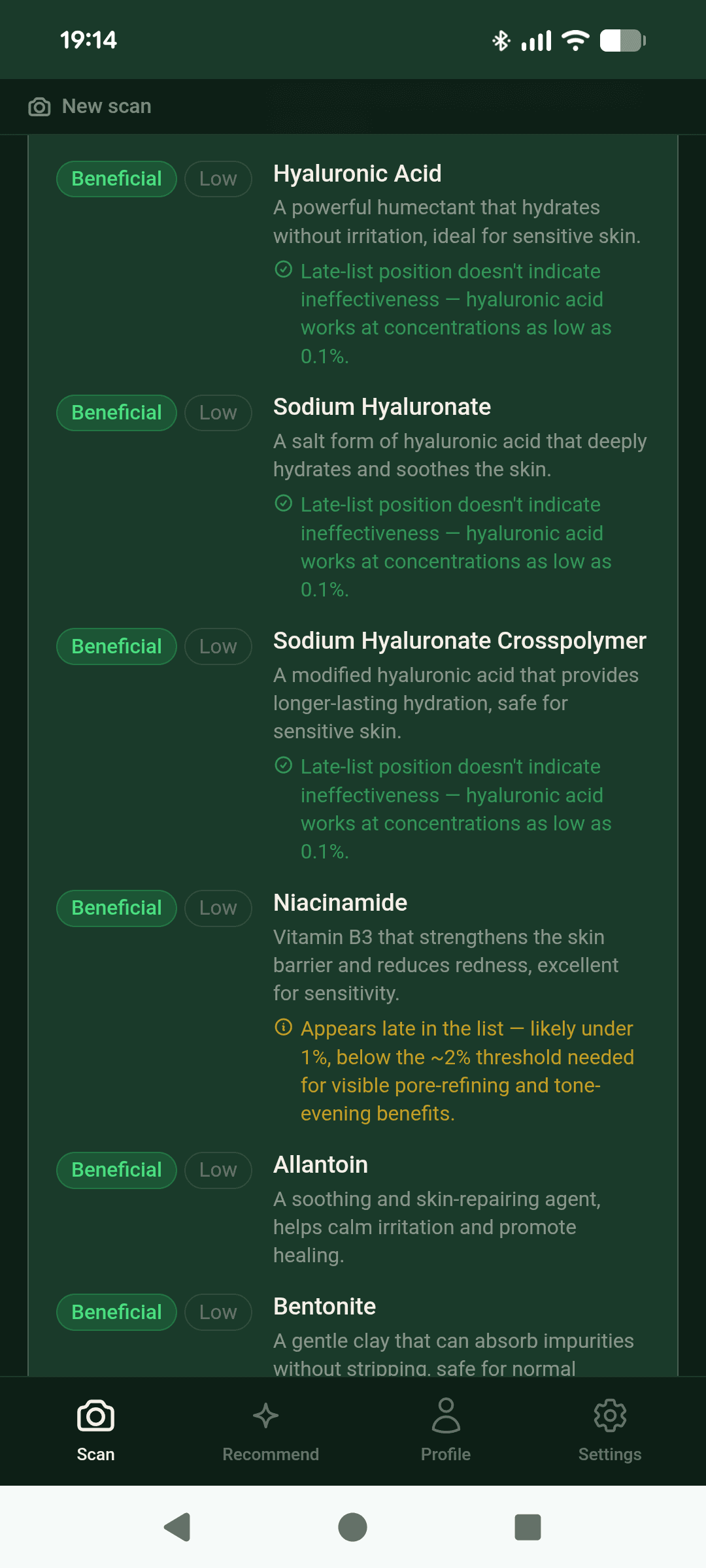
In the example above, both hyaluronic acid and niacinamide appear in the lower third of the ingredient list — the same "late position" signal. But Skanna interprets them differently, because they have different effective floors: hyaluronic acid is flagged as fine (it delivers real hydration even near 0.1%), while niacinamide is flagged as a concern (its effective threshold for visible pore and tone results starts around 2%, making a sub-1% position a genuine limitation). Same position; opposite conclusions. Getting that right by hand requires looking up each ingredient's clinical evidence separately — Skanna applies that reasoning in the scan.
Step 3: Scan for Red Flags and Green Flags
When checking cosmetic ingredients, it helps to have a mental checklist. Here's a quick reference:
| Category | Red Flags (worth investigating further) | Green Flags |
|---|---|---|
| Fragrance | Parfum, Fragrance (catch-all terms hiding hundreds of molecules) | Fragrance-free; or no Parfum/Fragrance entry |
| Allergens | Linalool, Limonene, Geraniol, Eugenol, Citronellol listed separately | No EU-declarable allergens present |
| Preservatives | DMDM Hydantoin, Imidazolidinyl Urea (release formaldehyde²); Methylparaben, Propylparaben (suspected endocrine disruptors³) | Phenoxyethanol ≤1%, Ethylhexylglycerin, Sodium Benzoate |
| Alcohols | Alcohol Denat., Isopropyl Alcohol high in the list | Cetearyl Alcohol, Cetyl Alcohol (fatty alcohols — beneficial) |
| Silicones | Cyclopentasiloxane, Cyclohexasiloxane (environmental concerns) | Dimethicone (safe but occlusive; personal preference) |
| Actives | Star active buried after 30+ other ingredients | Key actives in top half of the list |
One important nuance on allergens: the 80+ EU-regulated contact allergens must be listed separately once they exceed 0.001% in a leave-on product⁴. Their presence isn't an automatic deal-breaker — many people tolerate them fine — but if you have reactive or sensitive skin, seeing Linalool or Limonene is a signal to patch-test first.
Step 4: Cross-Check Against Official Databases
For any ingredient you're unsure about, two free official sources are definitive:
- CosIng (EU Cosmetic Ingredients database): lists every ingredient approved or restricted in EU cosmetics, with official classifications and maximum permitted concentrations⁵. If an ingredient has a restriction, it'll appear here.
- PubChem (NIH): molecular data, safety data, and alternate names — useful when an ingredient appears under an unfamiliar chemical synonym⁶.
A practical shortcut: search the ingredient name + "CosIng" or "CIR" (Cosmetic Ingredient Review). The CIR publishes independent safety assessments for thousands of cosmetic ingredients⁷.
If you'd rather use a dedicated app or tool to handle this cross-checking automatically, see our comparison of free skincare ingredient checkers — covering barcode scanners, paste-in web tools, and AI-powered analyzers side by side.
Step 5: Consider Interactions and Your Skin Profile
Ingredients don't exist in isolation — context matters:
- pH-sensitive actives: vitamin C (Ascorbic Acid) needs a formula pH below 3.5 to be effective; most labels don't publish pH, but position and supporting ingredients (like citric acid) are hints
- Antagonistic combos: retinol and AHAs can over-exfoliate if layered — check both products before building a routine
- Occlusion and acne: highly occlusive ingredients (petrolatum, mineral oil, heavy silicones) can worsen comedone-prone skin
Real Example: Checking a Moisturiser Before Buying
Here's how to check cosmetic ingredients on a realistic moisturiser INCI list, step by step:
Aqua, Glycerin, Niacinamide, Caprylic/Capric Triglyceride, Cetearyl Alcohol, Dimethicone, Phenoxyethanol, Sodium Hyaluronate, Tocopherol, Parfum, Linalool, Limonene, Ethylhexylglycerin, Citric Acid
Reading it systematically:
1. Aqua — water, the base. Perfectly normal at position 1 in an emulsion.
2. Glycerin — high-concentration humectant. Its position at #2 suggests a meaningful amount (likely 5–15%), which is exactly what you want for a moisturiser.
3. Niacinamide — the featured active, in position 3. This is strong placement; it's almost certainly present at 3–5% or more, well within the clinically effective range for pore-minimising and tone-evening effects. ✓
4. Caprylic/Capric Triglyceride — a lightweight, well-tolerated emollient derived from coconut oil. Good skin feel without the comedogenicity of heavier oils. ✓
5. Cetearyl Alcohol — a fatty alcohol (not a drying alcohol), used as an emulsifier. Safe and beneficial for skin barrier. ✓
6. Dimethicone — a silicone that adds slip and smooth texture. Not harmful, but occlusive — worth noting if you're acne-prone.
7. Phenoxyethanol — the primary preservative. Its position here is consistent with the EU-mandated 1% cap. ✓
8. Sodium Hyaluronate — the salt form of hyaluronic acid, positioned after the preservative (so likely below 1%). Even at 0.1–0.5% it contributes useful hydration, though less dramatically than mid-list concentrations.
9. Tocopherol — vitamin E antioxidant. Effective even at trace levels; its position is fine. ✓
10. Parfum — generic fragrance term. This is a watchpoint: it could contain any number of sensitising molecules not individually listed.
11–12. Linalool, Limonene — two regulated allergens declared separately because they exceed the legal threshold in a leave-on product. Both are common in floral/citrus fragrances.
13. Ethylhexylglycerin — secondary preservative and skin-conditioning agent. Well-tolerated. ✓
14. Citric Acid — pH adjuster. Confirms the formula was pH-corrected, which is a positive sign for active stability.
Verdict: a well-formulated moisturiser with niacinamide at a genuinely effective concentration and a clean preservative system. The fragrance and its allergens (Linalool, Limonene) are the only watchpoint — if you have reactive skin, look for a fragrance-free version of the same base. Everything else is well-placed and appropriate.
The 5-Question Pre-Buy Checklist
Before adding a product to your cart, ask yourself:
- Is the INCI list published? If not — skip or contact the brand.
- Where does the featured active appear in the list? Mid-list or higher = meaningful concentration. Bottom third = likely negligible.
- Is Parfum or Fragrance present? If yes, are you okay with that for your skin type?
- Are any EU-declarable allergens individually listed? If yes, and you have sensitive skin — patch test.
- Are there any restricted or flagged preservatives? Cross-check with CosIng if unsure.
Answering these five questions takes under two minutes once you know what you're looking for — and can save you from wasting money on a product that will irritate your skin or underdeliver on its promises.

Check your own products in seconds
Scan a barcode or the ingredient list — Skanna tells you whether the formula is good and whether it suits your skin.
Try Skanna freeFree: 5 scans and 5 recommendations a week · Sign in with Google
Frequently Asked Questions
What should I check on a skincare label before buying?
Before buying any skincare product, check the INCI ingredient list — not just the front-of-pack marketing. Specifically: (1) the position of key actives to gauge concentration, (2) the presence of Parfum or Fragrance which can mask sensitising molecules, (3) any EU-regulated allergens listed individually, (4) preservatives you know you react to, and (5) whether the formula has been pH-adjusted (look for Citric Acid or Sodium Hydroxide near the end). Two minutes of label reading beats three weeks of testing a product your skin won't tolerate.
How can I tell if a product contains allergens?
To verify skincare ingredients for allergens, scan the INCI list for the 80+ EU-regulated contact allergens that must be declared individually above legal thresholds: Linalool, Limonene, Geraniol, Citronellol, Eugenol, Benzyl Alcohol, Cinnamal, Coumarin, and others. In leave-on products, they must appear if they exceed 0.001%⁴. Note that the umbrella term "Parfum" or "Fragrance" can still conceal many additional fragrance molecules not covered by that list — for reactive skin, fragrance-free is the safest choice.
Are ingredients at the bottom of the INCI list important?
Yes — they can be decisive in both directions. Below the 1% threshold, brands may list ingredients in any order, but those entries still matter: a trace allergen can trigger a reaction, a formaldehyde-releasing preservative can irritate, and even 0.1–0.3% retinol is biologically active. Never dismiss the end of the ingredient list when checking cosmetic ingredients for safety.
How do I know if a skincare active is present at an effective concentration?
Use the INCI list order as a proxy for concentration, then match position against known effective ranges. Anything that appears after the first preservative in the list is almost certainly below 1%. For niacinamide, you want it in the top 5 ingredients (≥2–5%). For retinol, even 0.1% is useful. For vitamin C (Ascorbic Acid), you want it high on the list — 10%+ at low pH. If the active you're buying the product for appears in the last third of a long ingredient list, reconsider whether the concentration justifies the price.
Sources / References
¹ EU Regulation (EC) No 1223/2009 on cosmetic products — Article 19 (labelling requirements): eur-lex.europa.eu
² Safety assessment of formaldehyde-releasing preservatives — Cosmetic Ingredient Review (CIR): cir-safety.org
³ CosIng entry for Methylparaben and Propylparaben — EU Commission: ec.europa.eu/growth/tools-databases/cosing
⁴ EU Regulation (EC) No 1223/2009, Annex III — Restricted substances including fragrance allergens declaration thresholds: eur-lex.europa.eu. Annex III was amended by Regulation (EU) 2023/1545, which expanded the individually-labelled allergen list from 26 to over 80 substances (transition running to 31 July 2028): eur-lex.europa.eu
⁵ CosIng — EU Cosmetic Ingredients and Substances database: ec.europa.eu/growth/tools-databases/cosing
⁶ PubChem (NIH) — open chemistry database for ingredient molecular data: pubchem.ncbi.nlm.nih.gov
⁷ Cosmetic Ingredient Review (CIR) — independent safety assessments: cir-safety.org
Check your own products in seconds
Scan a barcode or the ingredient list — Skanna tells you whether the formula is good and whether it suits your skin.
Try Skanna freeFree: 5 scans and 5 recommendations a week · Sign in with Google