Best Skincare Ingredient Checker (Free Tools Compared)
The best free skincare ingredient checker gives you science-backed, honest information about what's in your products — before you put them on your skin or spend money on something that won't perform.
But "ingredient checker" covers a wide range of tools. Some decode individual ingredients with links to published research. Others scan barcodes and return a quick score. A few use AI to reason about concentration levels rather than just noting what's present. Which one you need depends on what question you're actually trying to answer.
This comparison covers the six most widely used free tools for checking cosmetic ingredients, with an honest account of what each does well and where it falls short — plus a table you can scan at a glance.
What Is a Skincare Ingredient Checker?
A skincare ingredient checker is a tool or app that lets you look up, decode, and evaluate the ingredients in a cosmetic or skincare product — typically based on the INCI (International Nomenclature of Cosmetic Ingredients) list printed on the packaging.
To understand the INCI system itself — how ingredients are named, ordered by concentration, and regulated across markets — see our complete guide to reading an INCI ingredient list.
What Makes a Good Free Ingredient Checker?
A good skincare ingredient checker does more than assign a traffic-light color. The five qualities that separate genuinely useful tools from superficial ones:
- Ingredient-level detail: does it explain what an ingredient does and why it might be a concern, or just flag red without context?
- Concentration awareness: does it consider where an ingredient appears in the INCI list — a reliable proxy for relative concentration — or treat all listed ingredients as equally present?
- Skin profile fit: does it give the same result to everyone, or adapt to your skin type, sensitivities, and specific concerns?
- Data traceability: are ratings traceable to official regulatory sources like CosIng¹, the CIR², or EWG³ — or derived from unattributed consensus?
- Input flexibility: can it read a barcode or photograph a label, or does it require manual copy-paste?
No single free tool scores perfectly on all five. The table below shows how each one compares.
Comparison at a Glance
| Tool | Free Tier | Input Method | Languages | Standout Feature |
|---|---|---|---|---|
| INCIDecoder | Fully free | Paste INCI list | English | Research-backed per-ingredient explanations |
| CosDNA | Fully free | Paste INCI list | English | Comedogenicity + irritation rating per ingredient |
| INCI Beauty | Free + premium | Barcode scan | FR, EN + others | French-native; EU/US/Canada regulatory data |
| Yuka | Free + premium | Barcode scan | FR, EN, 10+ | Food + cosmetics; 58M+ users |
| EWG Skin Deep | Fully free | Search or barcode | English | 1–10 hazard scale; 75,000+ personal care products |
| Skanna | 5 scans/week free | Barcode scan or label photo | FR + EN | Two scores: formula quality + fit for your skin |

Check your own products in seconds
Scan a barcode or the ingredient list — Skanna tells you whether the formula is good and whether it suits your skin.
Try Skanna freeFree: 5 scans and 5 recommendations a week · Sign in with Google
The Tools, Compared
INCIDecoder
INCIDecoder (incidecoder.com) is a free, entirely web-based tool with no paid tier. You paste or type an INCI list, and it returns a breakdown of each ingredient: what it does, which skin benefit it's associated with, any known irritancy or comedogenicity concerns, and links to published research where available.
Its strength is ingredient research — when you want to understand why something is flagged, or what clinical evidence exists for a particular active. The database is updated continuously with new ingredient entries and product profiles.
What it doesn't do: no barcode scanning, and the mobile experience is limited. There's no skin profile — every user gets the same analysis for the same ingredient, regardless of skin type or sensitivities. You also need to source the INCI list yourself from the packaging or a product page.
Best for: deep research into specific ingredients or unfamiliar INCI names; verifying the evidence base for a featured active before buying.
CosDNA
CosDNA (cosdna.com) is a free web tool focused on safety and acne compatibility. Paste an ingredient list, and it returns a color-coded grid with per-ingredient ratings on two axes: acne potential (comedogenicity, 0–5) and irritation potential (0–5), with an overall safety classification. The database covers 15,000+ cosmetic ingredients and cites regulatory sources including CIR assessments and EWG data.
The grid format makes it fast to scan a long formula for the ingredients most likely to cause breakouts or sensitivity reactions — making it especially popular among acne-prone and sensitive skin communities.
What it doesn't do: the scores don't explain the reasoning behind them in depth, and — like INCIDecoder — it requires manual INCI input and doesn't account for ingredient concentration or individual skin type.
Best for: checking a formula's acne or irritation risk at a glance; a quick compatibility screen for sensitive or acne-prone skin.
INCI Beauty
INCI Beauty (incibeauty.com) is a free mobile app (iOS and Android) with an optional paid tier. Scan a product barcode to get a score between 0 and 20, alongside per-ingredient information sheets that include regulatory data for the EU, US, and Canada — useful if you're comparing products across markets.
The app was originally developed for French-speaking users and remains one of the strongest options for the FR/European market, with solid multilingual support. It also lets you search for cleaner alternatives when a product's score is low.
What it doesn't do: results depend on its product database — products not yet in the database may not return a full analysis. The 0–20 scoring is intuitive but doesn't surface concentration reasoning or personalise to your skin profile.
Best for: French-language users and those shopping EU or Canadian cosmetics who want a fast barcode scan with regulatory context.
Yuka
Yuka (yuka.io) is a free barcode-scanning app (with optional paid features) that covers both food and cosmetics. With over 58 million users, its product database coverage is extensive. Scan a barcode and get a simplified score along with a rating summary and alternative suggestions.
The simplicity is both its strength and its limitation: Yuka is excellent as a quick first impression and for users who want a single app for both grocery and beauty shopping. It's available in French, English, and over ten other languages.
What it doesn't do: the cosmetics analysis doesn't provide per-ingredient depth comparable to INCIDecoder or CosDNA, and doesn't reason about concentration or personalise results to your skin type.
Best for: quick, broad product screening; users who also check food labels and want one app; building general awareness of product quality across a full shopping basket.
EWG Skin Deep
EWG Skin Deep (ewg.org/skindeep) is a free database run by the Environmental Working Group, a US non-profit. It rates personal care products and their ingredients on a 1–10 hazard scale (1 = low concern, 10 = high concern), covering 75,000+ products. Ratings draw on peer-reviewed literature, government data, and regulatory assessments.
EWG's data is most directly relevant to US-market products and US regulatory frameworks. For concerns about potential endocrine disruptors or restricted substances, it is a credible and well-sourced reference point.
What it doesn't do: its hazard scale is US-regulatory-focused; for EU-specific restrictions, CosIng¹ is the authoritative source. Like the other database tools, it doesn't reason about concentration or adapt to individual skin profiles.
Best for: US-market products; checking ingredients against a well-sourced hazard scale; research into toxicology and endocrine concerns.
Skanna
Most tools in this comparison answer a consistent question: is this ingredient generally considered safe or problematic? Skanna (skanna.skin) asks something different: does this product suit your skin?
That shift matters more than it might sound. A glycolic acid exfoliant could be exactly right for an oily, breakout-prone skin and a bad fit for someone with a weakened barrier. A generic "watch" flag on the ingredient doesn't help you decide which situation you're in. Skanna does — because before it analyses anything, it asks you to set up a skin profile once: skin type, key concerns, known sensitivities. Every scan is then filtered through that profile. Two people scanning the same product may get different verdicts, because their skin has different needs.
Each result comes with two scores: ingredient quality — is this a good formula, full stop? — and for your profile — is it a good choice for your skin? A product can be well formulated and still not be made for you; Skanna tells you which, in one sentence.
To check a product, you scan its barcode. If it isn't in the database yet, you photograph the ingredient list instead. Either way it works while you're standing in a shop or pharmacy aisle, without looking the INCI list up yourself.
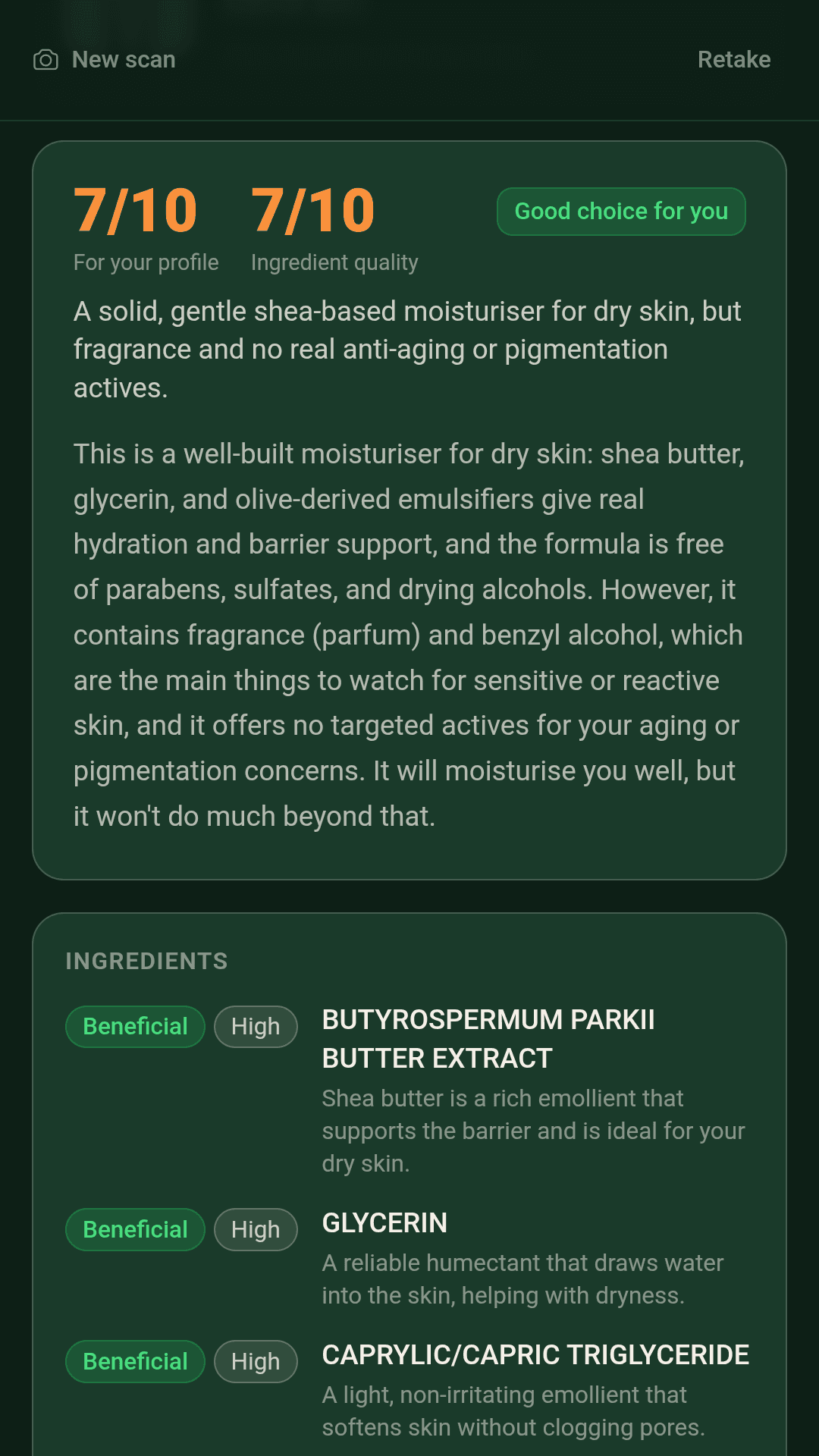
Beyond personalization, Skanna also reasons about concentrations: rather than simply confirming that an active is in the formula, it considers where it sits in the INCI list to estimate whether it's likely at a dose that does anything useful. Niacinamide starts delivering visible skin-tone results around 2%; an ingredient listed twenty-fifth out of thirty is almost certainly well below that threshold. Skanna flags these cases; most other tools don't distinguish between "present" and "present at an effective level."
Skanna also recommends products: describe what you're looking for and your budget, and it suggests products that are actually on sale, leaves out anything on your avoid list (fragrance, essential oils, drying alcohol…), and ranks the rest by formula quality and fit with your skin. The free tier gives 5 scans and 5 recommendations per week.
Best for:
- Finding products that genuinely match your skin type and concerns, not just products with no flagged ingredients
- Checking something while in a shop without having to copy-paste an ingredient list
- Understanding whether the actives you're paying for are likely at a working concentration
- Automatically avoiding ingredients you react to
- French-speaking users who want a bilingual FR/EN tool
Check your own products in seconds
Scan a barcode or the ingredient list — Skanna tells you whether the formula is good and whether it suits your skin.
Try Skanna freeFree: 5 scans and 5 recommendations a week · Sign in with Google
Which Tool Is Right for You?
| If you want… | Use |
|---|---|
| Deep ingredient research with citations | INCIDecoder |
| Quick acne / irritation compatibility check | CosDNA |
| Barcode scan in French with EU regulatory context | INCI Beauty |
| One app for food + cosmetics, minimal effort | Yuka |
| US-market hazard ratings from a trusted non-profit | EWG Skin Deep |
| Personalised analysis from a barcode or photo, with two scores | Skanna |
Most people benefit from pairing two tools: a fast scan app for day-to-day product checks, and a research tool for digging into specific flagged ingredients. If you want a step-by-step manual approach — checking labels without relying on any app — see our guide to how to check skincare ingredients before buying a product.
Frequently Asked Questions
Is there a free app to check skincare ingredients?
Yes — several free tools exist, and they work in different ways. INCIDecoder and CosDNA are free web tools where you paste the INCI list to get a per-ingredient breakdown. INCI Beauty and Yuka are free apps that scan barcodes and score the whole product. EWG Skin Deep is a free database covering 75,000+ personal care products. Skanna offers a free tier (5 scans per week) with AI-powered analysis from a barcode scan or a label photo, personalised to your skin profile. The right choice depends on whether you need depth, speed, personalization, or a specific language.
How accurate are skincare ingredient checker apps?
Accuracy depends on what the tool measures and how it sources its data. For ingredient identification and basic safety flags, tools drawing on CIR², CosIng¹, and EWG³ regulatory data are generally reliable. The gap most free tools don't address is concentration: they confirm an ingredient is present, but not whether it's at an effective level — which requires knowing where it sits in the INCI list relative to the ~1% threshold. AI-based tools apply this reasoning automatically; traditional database tools return the same answer regardless of position.
What is the difference between a skincare ingredient checker and an ingredient analyzer?
The terms are used interchangeably, but there is a meaningful functional distinction. An ingredient checker identifies what's in a product and flags known concerns — it's a lookup function. An ingredient analyzer goes further: it reasons about ingredient interactions, estimates likely concentrations from INCI list position, and evaluates whether the formula suits a specific skin type or concern. Most free tools are checkers. AI-based tools like Skanna are better described as analyzers, because they apply reasoning rather than just pattern-matching against a database.
Sources / References
¹ CosIng — EU Cosmetic Ingredients and Substances database: ec.europa.eu/growth/tools-databases/cosing
² Cosmetic Ingredient Review (CIR) — independent safety assessments: cir-safety.org
³ EWG (Environmental Working Group) Skin Deep database: ewg.org/skindeep
Check your own products in seconds
Scan a barcode or the ingredient list — Skanna tells you whether the formula is good and whether it suits your skin.
Try Skanna freeFree: 5 scans and 5 recommendations a week · Sign in with Google