How to Read an INCI Ingredient List: The Complete Guide to Decoding Your Cosmetics
Have you ever turned over a moisturiser to try decoding that endless list of strange names? Aqua, Glycerin, Niacinamide, Phenoxyethanol, Parfum… That's the INCI nomenclature — the universal language of cosmetics.
Understanding INCI means taking back control of what you apply to your skin every day — and the best way to check skincare ingredients for safety rather than trusting marketing claims. Here's everything you need to know.
What Is INCI Nomenclature?
INCI (International Nomenclature of Cosmetic Ingredients) is a standardised naming system created in the 1970s by the Personal Care Products Council. Since 1997, European regulations require all manufacturers to display the INCI list on every cosmetic product¹.
Each ingredient appears under its Latin name (plants and oils) or English name (synthetic molecules), which means you can find the same ingredient under the same name regardless of the brand or country of origin.
Concrete example: what you know as "vitamin C" appears in INCI as Ascorbic Acid or Sodium Ascorbyl Phosphate. "Aloe vera" becomes Aloe Barbadensis Leaf Juice.
The Fundamental Rule: Concentration Order
This is the most important thing to know when you want to use a skincare ingredient analyzer approach. Ingredients are listed in descending order of concentration in the formula¹.
- Top of the list: the most abundant ingredients — often
Aqua(water), followed by humectants likeGlycerin - Middle of the list: the main actives at effective concentrations
- End of the list: ingredients below 1%, typically preservatives, fragrances, and high-end actives
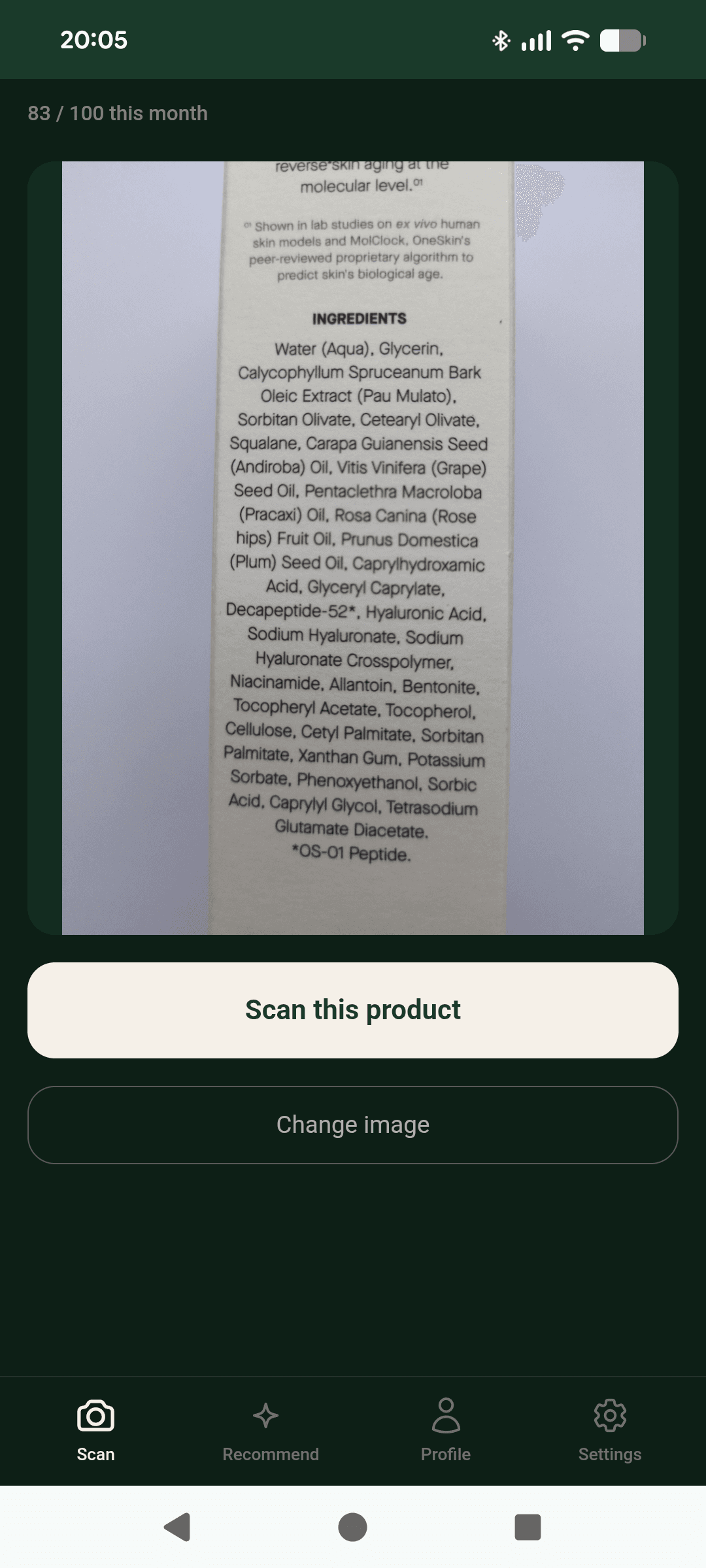
Here's what a real ingredient list you might analyse with this method looks like:
The Famous 1% Threshold
Once an ingredient falls below 1% concentration, regulations allow brands to list those ingredients in any order they choose. This is often where the star actives marketed on the packaging hide.
Practical tip: if a heavily-promoted active (niacinamide, retinol, peptides) appears right at the bottom of the list, it's likely present at less than 0.1%. Its real-world effectiveness is then very limited — or practically negligible.
The Major Ingredient Families
Solvents and Bases
These ingredients form the product's structure.
| INCI Name | Role |
|---|---|
| Aqua | Base, hydrophilic vehicle |
| Glycerin | Humectant, retains moisture in the skin |
| Butylene Glycol | Solvent, light hydration |
| Propylene Glycol | Versatile solvent and humectant |
| Isopropyl Alcohol | Fast-evaporating solvent, can dry skin at high concentrations |
Moisturising and Repair Actives
| INCI Name | Benefit |
|---|---|
| Hyaluronic Acid / Sodium Hyaluronate | Intense hydration, plumping effect |
| Niacinamide | Evens skin tone, fades hyperpigmented spots, soothes redness³ |
| Ceramide NP, AP, EOP | Restores and reinforces the skin barrier |
| Panthenol | Soothing and repairing (pro-vitamin B5) |
| Urea | Keratolytic humectant, ideal for very dry skin |
Anti-Ageing Actives
- Retinol / Retinyl Palmitate / Retinal: stimulate cell turnover; photosensitising, use at night only
- Ascorbic Acid: pure vitamin C, powerful antioxidant but unstable to light and air
- Sodium Ascorbyl Phosphate: stabilised form of vitamin C, better tolerated
- Peptides (any ingredient ending in -peptide or starting with numbers like Palmitoyl Tripeptide-1): firming, collagen-stimulating
Sunscreens
| Type | INCI Examples |
|---|---|
| Mineral (well-tolerated by sensitive skin) | Titanium Dioxide, Zinc Oxide |
| Chemical (broad UVA/UVB spectrum) | Octocrylene, Avobenzone, Tinosorb S |
| Worth monitoring | Benzophenone-3 (oxybenzone), Homosalate |
Cosmetic Ingredients to Avoid — and Why
Preservatives and Endocrine Disruptors in Cosmetics
Preservatives are essential for preventing bacterial growth and mould. Some are better tolerated than others depending on your skin profile — and several are monitored as potential endocrine disruptors — which has earned them specific EU concentration limits⁴.
| Preservative | Tolerance Profile |
|---|---|
| Phenoxyethanol | Generally well-tolerated (capped at 1% in EU⁶) |
| Ethylhexylglycerin | Good profile, often paired with the above |
| Sodium Benzoate | Safe, but can form benzene in the presence of vitamin C |
| Methylparaben, Propylparaben | Permitted in the EU; propylparaben capped at 0.14%⁴. Endocrine-disrupting effect not confirmed by the SCCS⁵ |
| DMDM Hydantoin, Imidazolidinyl Urea | Release formaldehyde, potential irritant |
Our upcoming in-depth guide to cosmetic ingredients to avoid will cover each category with recommended alternatives.
How to Spot Allergens in Cosmetic Ingredients: Fragrances
The generic term Parfum (or Fragrance) can mask dozens — even hundreds — of different undeclared molecules. It is one of the leading causes of contact allergy to cosmetics, and one of the most common hidden ingredients to avoid in skincare for reactive or sensitive skin types.
EU regulations require separate declaration of the over 80 recognised contact allergens whenever they exceed²:
- 0.01% in a rinse-off product
- 0.001% in a leave-on product
That list grew from 26 to over 80 substances under Regulation (EU) 2023/1545⁷. The transition is still running: from 31 July 2026, non-compliant products can no longer be placed on the market, and stock already on shelves can still be sold until 31 July 2028. So depending on how old the product in your hand is, you may see either the old list or the new one.
Common allergens to look for in the ingredient list: Linalool, Limonene, Geraniol, Citronellol, Eugenol, Benzyl Alcohol, Cinnamal.
If you have sensitive skin or a history of fragrance allergy, actively search for these terms in the INCI list.
Silicones
Recognisable by endings in -cone, -siloxane, or -conol, silicones deliver a silky finish and smooth the skin short-term. They are controversial for their occlusive effect and extremely low biodegradability.
Examples: Dimethicone, Cyclopentasiloxane, Cyclohexasiloxane, Amodimethicone.
Mineral Oils
Derived from petroleum refining, they are occlusive and very inexpensive. Well-tolerated by most skin types, but controversial in "clean beauty."
To look for: Paraffinum Liquidum, Petrolatum, Mineral Oil, Cera Microcristallina.
Reading a Real Moisturiser Ingredient List — Step by Step
Here is a realistic INCI list and how to decode it methodically:
Aqua, Glycerin, Niacinamide, Butylene Glycol, Dimethicone, Cetearyl Alcohol, Phenoxyethanol, Tocopherol, Sodium Hyaluronate, Parfum, Linalool, Limonene
Position 1 — Aqua: pure water, the universal solvent. Its presence at the top is virtually universal in emulsions. It typically makes up 60–80% of the product.
Position 2 — Glycerin: high-concentration humectant (often 5–15%). One of the most effective and well-tolerated moisturising actives available.
Position 3 — Niacinamide: the star active, in a strong position — likely 3–5%. At this concentration, its effects on skin tone, hyperpigmented spots and redness are clinically documented³.
Position 4 — Butylene Glycol: solvent and co-humectant. Usually 2–5%. Improves texture and the penetration of other actives.
Position 5 — Dimethicone: emollient silicone that provides glide and a silky skin feel. Concentration likely 1–3%.
Position 6 — Cetearyl Alcohol: a fatty alcohol (not a drying alcohol) used as an emulsifier and formula stabiliser. Safe; typically 1–3%.
Position 7 — Phenoxyethanol: the standard EU preservative, capped at 1% by regulation. Its position here is consistent with that limit.
Positions 8–9 — Tocopherol and Sodium Hyaluronate: antioxidant (vitamin E) and hydrating (hyaluronic acid) actives, likely below 1%. Tocopherol is effective even at trace levels; hyaluronic ideally needs ≥ 0.1% for meaningful effect.
Position 10 — Parfum: generic fragrance. A potential allergy trigger — keep an eye on what follows.
Positions 11–12 — Linalool, Limonene: two regulated contact allergens derived from the fragrance, declared separately because they exceed the threshold. An amber flag for sensitive skin.
Verdict on this list: an honest, well-built formula with niacinamide at a genuinely effective concentration. The fragrance and its associated allergens are the only watchpoint for reactive skin types.
The 5 Golden Rules for Reading an INCI List
- Order = concentration: the first ingredients dominate the formula — always check them first
- The 1% threshold: actives heavily promoted on the front of the pack can be present in token amounts
- "Parfum": a catch-all term that potentially masks hundreds of molecules — the first suspect in a skin reaction
- Preservatives: necessary, but choose them based on your sensitivities and values
- Latin name ≠ natural ingredient: a petrochemical derivative can have a Latin-sounding INCI name — don't be fooled by appearances
Once you have these rules down, you can apply them every time you pick up a new product. Our step-by-step guide on how to check skincare ingredients before buying walks you through exactly what to look at — and what questions to ask — when you're standing in the aisle or shopping online.
Why It's Hard to Do Alone
In practice, memorising and cross-referencing all this information for every product you buy is unrealistic. A typical INCI list contains between 15 and 50 ingredients. Some have synonyms, similar names with very different properties, and interactions between them that only a specialist database can detect.
That's where Skanna comes in — a skincare ingredient analyzer that does the work for you.
Scan a product's barcode — or photograph its INCI list — and Skanna will:
- Automatically identify every ingredient, even the most complex ones
- Rank the risks according to your personal skin profile (sensitive, acne-prone, mature, oily, dry)
- Flag allergens and any ingredients you've asked to avoid
- Give you two scores — ingredient quality and fit for your skin — and a personalised verdict in seconds
No more searching each ingredient across dozens of browser tabs — Skanna handles it, based on your skin profile.
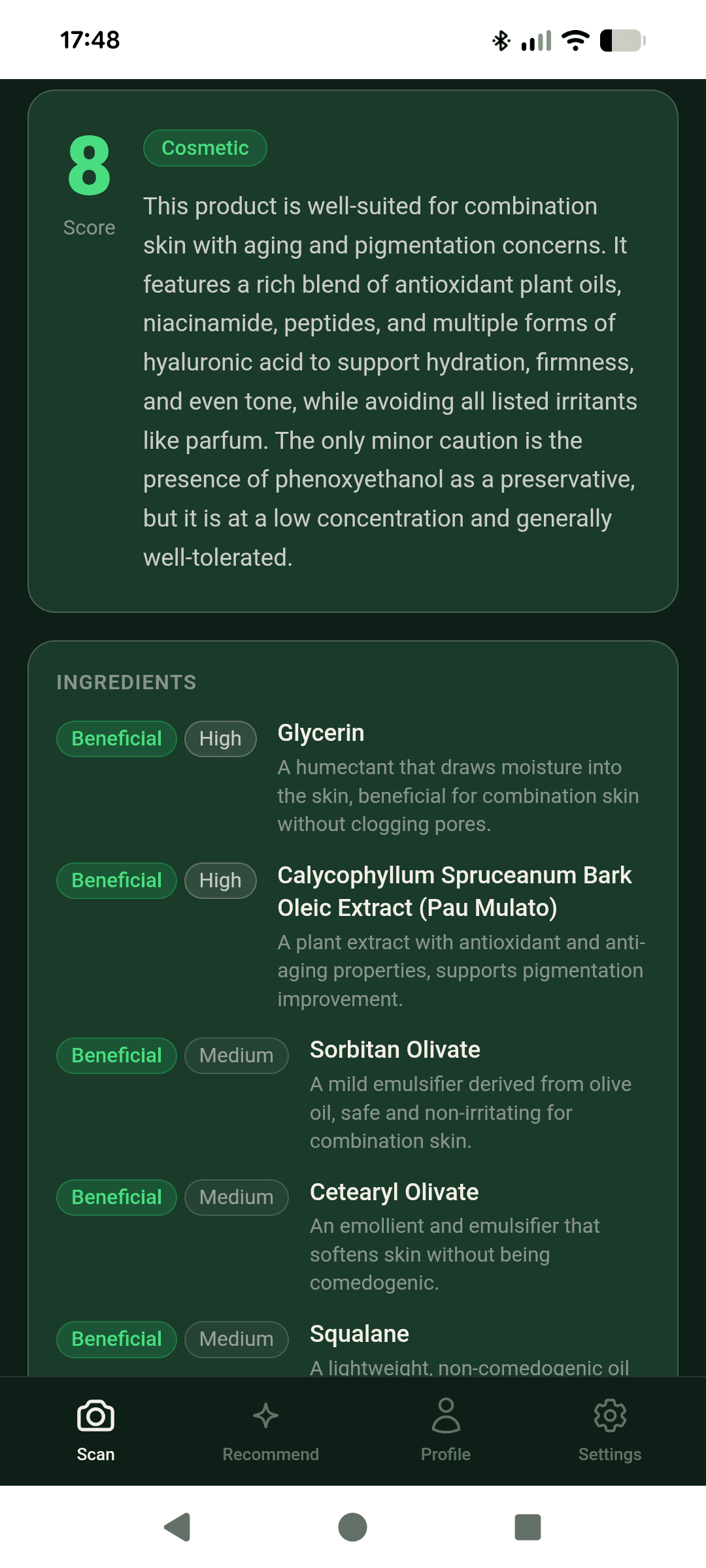
Here's what that analysis looks like in practice — a real Skanna scan automatically scoring a product and breaking down each ingredient's role:

Check your own products in seconds
Scan a barcode or the ingredient list — Skanna tells you whether the formula is good and whether it suits your skin.
Try Skanna freeFree: 5 scans and 5 recommendations a week · Sign in with Google
Frequently Asked Questions About INCI Lists
What does Aqua mean in an INCI list?
Aqua is the INCI name for water — the most common cosmetic ingredient by far. It serves as the solvent and carrier that holds all other ingredients in suspension, and typically makes up 60–80% of cream or lotion formulas. An anhydrous product (oil, balm, stick) contains no Aqua. Seeing Aqua first on an ingredient list is normal and expected; it tells you the formula is water-based.
What does Parfum or Fragrance mean in cosmetics?
Parfum (EU) and Fragrance (USA) are umbrella terms that can conceal hundreds of undisclosed molecules. They are among the most frequent hidden ingredients to avoid in skincare for reactive skin, as fragrance is the number-one cause of cosmetic contact allergy. EU law requires the separate listing of over 80 regulated allergens above certain thresholds, but the majority of fragrance compounds remain anonymous behind this single word.
How can I tell if a product contains allergens?
Look for the 80+ EU-regulated contact allergens listed individually in the INCI: Linalool, Limonene, Geraniol, Citronellol, Eugenol, Benzyl Alcohol, Cinnamal, Coumarin, and more. They must appear separately once they exceed 0.001% in a leave-on product. A dedicated skincare ingredient analyzer like Skanna automates this scan and personalises alerts based on your own skin history and sensitivities.
Are ingredients at the bottom of the INCI list important?
Yes. Below 1%, order is no longer regulated, but those last entries can still matter enormously — both positively (a high-performance peptide or retinol works even at 0.1–0.3%) and negatively (an allergen or a suspected endocrine disruptor is still biologically active at trace levels). Don't dismiss the fine print at the end of the list — it's often where the most important safety signals hide.
What ingredients should sensitive skin avoid?
Sensitive skin should prioritise avoiding fragrance compounds (Parfum, Fragrance, and the regulated allergens like Linalool and Limonene), drying alcohols (Alcohol Denat. and Isopropyl Alcohol at high concentrations), formaldehyde-releasing preservatives (DMDM Hydantoin, Imidazolidinyl Urea), and high-strength exfoliating acids. Our upcoming sensitive skin care guide will walk through the best alternatives.
Can two products with the same active ingredient have different effectiveness?
Absolutely — and this is one of the most misunderstood aspects of how to check skincare ingredients for safety and efficacy. Concentration, molecular form, formula pH, and supporting ingredients all shape how an active performs. A 20% pure vitamin C (Ascorbic Acid) serum formulated at pH 3.5 is dramatically more potent than a 1% derivative at neutral pH, even though both are technically "vitamin C." Always check position in the list and form — not just the marketing claim on the front.
Ready to analyse your products? Create your skin profile on Skanna and get a personalised verdict for free.
References / Sources
¹ Regulation (EC) No 1223/2009 on cosmetic products — Article 19 (labelling and descending order of concentration in the INCI list): eur-lex.europa.eu
² Regulation (EC) No 1223/2009 — Annex III (fragrance allergens subject to individual labelling, with the 0.001% / 0.01% thresholds): eur-lex.europa.eu
³ Bissett DL, Oblong JE, Berge CA. "Niacinamide: A B Vitamin that Improves Aging Facial Skin Appearance," Dermatologic Surgery, 2005;31(7 Pt 2):860-865 — double-blind trial, 5% topical niacinamide over 12 weeks: onlinelibrary.wiley.com
⁴ Commission Regulation (EU) No 1004/2014 — restriction of propylparaben and butylparaben (0.14% cap, banned in leave-on nappy-area products for children under 3): eur-lex.europa.eu
⁵ SCCS (Scientific Committee on Consumer Safety), Opinion SCCS/1623/20 on propylparaben — concludes it is safe up to 0.14% and states that its suspected endocrine-disrupting properties cannot be confirmed on the basis of the available data: health.ec.europa.eu
⁶ CosIng — the EU cosmetic ingredient database, including the EU concentration limit for Phenoxyethanol (Annex V): ec.europa.eu/growth/tools-databases/cosing
⁷ Commission Regulation (EU) 2023/1545 amending Annex III of Regulation (EC) No 1223/2009 — expands the individually-labelled fragrance allergen list from 26 to over 80 substances. Transitional provisions: placing on the market until 31 July 2026, making available on the market until 31 July 2028: eur-lex.europa.eu
Check your own products in seconds
Scan a barcode or the ingredient list — Skanna tells you whether the formula is good and whether it suits your skin.
Try Skanna freeFree: 5 scans and 5 recommendations a week · Sign in with Google