12 cosmetic ingredients to avoid (and why)
Turn over almost any skincare product and you'll find an ingredient list dense with unfamiliar names. Add social media "toxin-free" culture into the mix, and it becomes almost impossible to tell which warnings are grounded in science and which are pure marketing.
The reality is more nuanced than either extreme. The vast majority of cosmetic ingredients — however chemical-sounding — are assessed under strict regulatory frameworks. But some have genuine profiles worth knowing about, especially for sensitive skin, pregnant women, and young children. This guide covers the 12 most debated cosmetic ingredients to avoid or monitor, with honest context on what the evidence actually shows.
To understand how these ingredients appear in product formulas, start with our guide on how to read an INCI ingredient list.
The 12 cosmetic ingredients to look out for on a label
1. Parfum / Fragrance
What it is: A catch-all term that can conceal hundreds of individual molecules, none of which need to be declared separately under this label.
Why it matters: Fragrance is the leading cause of contact allergy in cosmetics. Under EU regulations, over 80 specific contact allergens derived from fragrance must be declared separately above threshold concentrations — but the bulk of fragrance chemistry still hides behind this single word. To spot allergens in cosmetic ingredients, scan for separately listed names: Linalool, Limonene, Geraniol, Citronellol, Eugenol, Cinnamal, Benzyl Alcohol. The FDA currently requires only that "Fragrance" be listed as a collective term, without specifying individual components.
Where it appears: Moisturisers, body lotions, shower gels, shampoos, deodorants, micellar waters.
Who it affects most: Sensitive, reactive, or eczema-prone skin; anyone with a fragrance allergy history.
2. Phenoxyethanol
What it is: A synthetic preservative that became the dominant alternative after the partial EU paraben restrictions in 2014.
Why it matters: Approved up to 1% in the EU and permitted in the US, it is generally well-tolerated by adults. France's ANSM issued a precautionary warning against its use in products for infants under 3 years old and on nappy-area skin. For healthy adults, the risk is low. Some people with very sensitive skin experience mild irritation — switching products usually resolves it.
Where it appears: Virtually any water-based cosmetic: creams, serums, lotions, after-sun products.
3. Parabens (Methylparaben, Propylparaben…)
What they are: A family of preservatives used for decades for their broad-spectrum efficacy and generally good tolerance profile.
Why they matter: Five long-chain parabens were banned in the EU in 2014 due to suspected endocrine-disrupting properties. Methylparaben and ethylparaben remain permitted at regulated maximum concentrations. The FDA has not banned any parabens but has monitored them since 2005. The main concern is long-term cumulative exposure, particularly for pregnant women, infants, and people with hormone-sensitive conditions.
Where they appear: Moisturisers, foundations, mascaras, hair care products.
4. Formaldehyde and formaldehyde-releasing preservatives
What they are: Formaldehyde itself is classified as a Category 1B carcinogen (EU) and a known human carcinogen (IARC). It is banned as a direct cosmetic ingredient in the EU except at very low concentrations in nail hardeners. However, certain preservatives release small amounts of formaldehyde as they break down.
Why they matter: Formaldehyde-releasers — DMDM Hydantoin, Imidazolidinyl Urea, Diazolidinyl Urea, Quaternium-15, Bronopol — are approved at low concentrations but can cause allergic reactions and irritation, particularly in sensitised individuals. The EU's Scientific Committee on Consumer Safety (SCCS) has flagged this category for ongoing review.
Where they appear: Shampoos, conditioners, styling products, hand creams, some face masks.
5. Mineral oils (Paraffinum Liquidum, Petrolatum)
What they are: Petroleum-derived emollients and occlusive agents widely used for their stability and low cost.
Why they matter: Highly refined cosmetic-grade mineral oils are considered safe by both EU and FDA regulatory frameworks. The concern centres on inadequately refined grades (MOSH/MOAH — mineral oil saturated/aromatic hydrocarbons), which may contain potentially carcinogenic contaminants. For mainstream cosmetics using pharmaceutical-grade ingredients, the risk is minimal. Their occlusive nature can be problematic for acne-prone skin.
Where they appear: Lip balms, baby creams, foundations, makeup removers, petroleum jelly.
6. Silicones (Dimethicone, Cyclopentasiloxane…)
What they are: Silicon-based polymers that provide a smooth, silky texture and form a breathable barrier on skin. Recognisable by endings in -cone, -siloxane, or -conol.
Why they matter: Silicones are not toxic. The primary concern is environmental: they are extremely resistant to biodegradation and accumulate in aquatic ecosystems. The EU restricted Cyclopentasiloxane (D5) and Cyclohexasiloxane (D6) in rinse-off cosmetics from 2020 on environmental grounds. On skin, the occlusive effect can be a nuisance for acne-prone types — but this is a preference and tolerance issue, not a safety one.
Where they appear: Primers, foundations, smoothing serums, hair styling products, premium moisturisers.
7. PEG compounds (PEG-xx)
What they are: Polyethylene glycols used as emollients, humectants, solvents, and surfactants.
Why they matter: PEGs themselves are generally well-tolerated. The concern relates to their manufacturing process (ethoxylation), which can introduce trace contaminants — 1,4-dioxane and ethylene oxide — both classified as probable carcinogens. The level of contamination depends on the manufacturer's purification standards. EU and FDA regulations set maximum permitted levels for these contaminants. The concern is more relevant for damaged skin (cuts, burns) than intact healthy skin.
Where they appear: Moisturisers, cleansers, sunscreens, shampoos, waterproof makeup removers.
8. BHA and BHT (synthetic antioxidant preservatives — not the skincare acid)
What they are: Butylhydroxyanisole (BHA) and butylhydroxytoluene (BHT) are synthetic antioxidants used to prevent fats in cosmetics from going rancid.
Important clarification: These BHA/BHT preservatives are completely unrelated to the skincare beta-hydroxy acid (salicylic acid) also abbreviated as "BHA" in product marketing. They are different molecules with entirely different functions.
Why they matter: BHA (butylhydroxyanisole) is classified as a suspected endocrine disruptor by the EU and is under review as a potential CMR substance (carcinogenic, mutagenic, or reprotoxic). BHT is less concerning but also monitored. Both remain permitted at low concentrations in cosmetics. Several brands avoid them proactively as a precautionary measure.
Where they appear: Lipsticks, sunscreens, rich hair products, body butters.
9. Triclosan
What it is: A broad-spectrum antibacterial agent once ubiquitous in soaps, toothpastes, and deodorants.
Why to avoid it: Triclosan is classified as a suspected endocrine disruptor and is associated with antimicrobial resistance. The EU has banned triclosan from most cosmetic products; it is only permitted in toothpaste at a maximum of 0.3%. The FDA banned triclosan from over-the-counter antiseptic soaps in 2016, finding insufficient evidence of benefit over plain soap and water. It remains in some non-EU products available online — worth checking imported items.
Where it may still appear: Some toothpastes (at restricted levels in EU), certain imported personal care products.
10. Sulphates (Sodium Lauryl Sulfate / SLS, Sodium Laureth Sulfate / SLES)
What they are: Anionic surfactants that produce rich lather and cut through grease efficiently.
Why they matter: SLS and SLES are not acutely toxic, but SLS is a well-documented skin irritant at higher concentrations that disrupts the skin's lipid barrier. Studies show it can aggravate eczema, rosacea, and reactive skin conditions with repeated use. SLES is milder. For sensitive or dry skin, sulphate-free formulas using gentler alternatives (coco-glucoside, decyl glucoside, sodium cocoyl isethionate) are significantly better tolerated.
Where they appear: Shampoos, shower gels, foaming face washes, toothpastes.
11. Alcohol Denat. (denatured alcohol)
What it is: Ethanol rendered undrinkable by denaturing agents, used as a solvent, preservative, and texture-lightening agent.
Why it matters: At high concentrations, Alcohol Denat. disrupts the skin's protective barrier, accelerates water loss, and can cause irritation — particularly for dry, sensitive, or eczema-prone skin. Its position in the ingredient list matters: alcohol in positions 1–3 is a red flag for sensitive skin. In mid-list or lower positions at accessory concentrations, it is typically inconsequential.
Where it appears: Toners, lightweight serums, anti-acne treatments, aerosol sunscreens, deodorants.
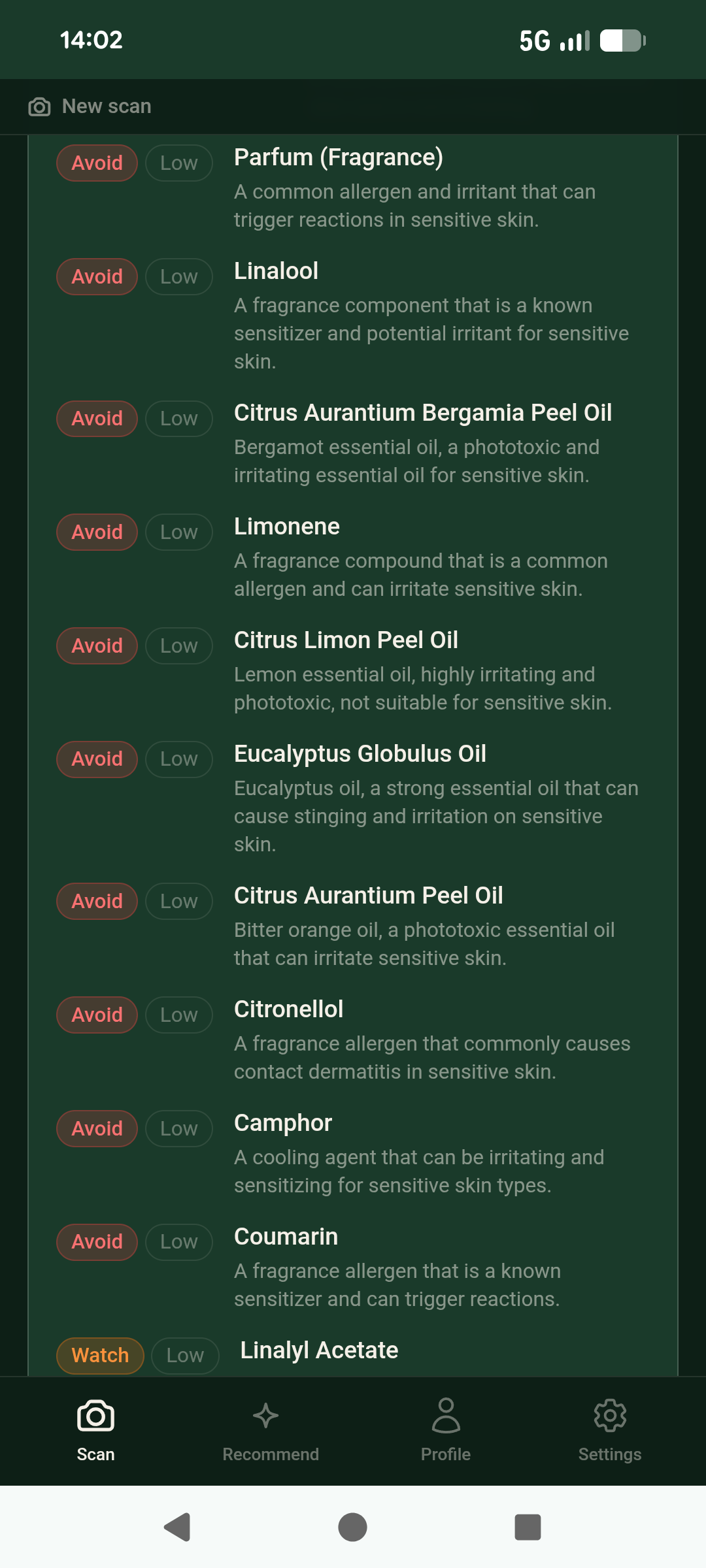
Skanna automatically flags irritating ingredients in the INCI list — fragrance allergens, essential oils, and drying alcohols
12. Oxybenzone (Benzophenone-3) — in sunscreens
What it is: A broad-spectrum chemical UV filter, one of the most effective and widely used sunscreen actives globally.
Why it matters: Oxybenzone is classified as a suspected endocrine disruptor by the EU. Animal studies demonstrate hormonal effects at high doses; the relevance to typical human cosmetic use remains scientifically debated. It is also a known photoallergen in sensitised individuals. In 2022 the EU reduced the maximum permitted concentration from 10% to 6%. The FDA currently considers oxybenzone "not generally recognised as safe and effective" and requires further safety data. It is also highly damaging to coral reef ecosystems — banned in Hawaii, Palau, and several other jurisdictions.
Where it appears: Sunscreens, SPF-rated foundations, tinted moisturisers with sun protection.
Endocrine disruptors in cosmetics: what you actually need to know
An endocrine disruptor is a substance that interferes with the body's hormonal system — by mimicking, blocking, or altering the production of natural hormones. Exposure to such substances has been associated with hormonal disorders and reproductive effects, but assessing the human risk from cosmetics specifically is complex.
What EU and US regulations say:
EU Regulation (EC) No 1223/2009 on cosmetic products bans substances classified as CMR (carcinogenic, mutagenic, or toxic for reproduction) categories 1A and 1B. Since 2018, the EU has developed formal criteria for identifying endocrine disruptors under its biocide and pesticide regulations — these criteria are increasingly being applied to cosmetics and personal care products under the EU Chemicals Strategy for Sustainability.
In the US, the FDA regulates cosmetic ingredients primarily under the Federal Food, Drug, and Cosmetic Act. There is no specific endocrine disruptor framework for cosmetics at the federal level, though the EU's more precautionary approach has influenced many global brands to reformulate for EU compliance.
The essential nuance:
Toxicology is fundamentally about dose. The presence of a suspected endocrine disruptor at a cosmetically permitted concentration is not the same as a demonstrated risk. Cumulative exposure, route of absorption, frequency of use, and individual factors — age, hormonal status, pregnancy — all determine real-world risk.
The highest-risk profiles are pregnant women, infants, and young children (whose endocrine systems are still developing), and people with hormone-sensitive conditions. For these groups, a precautionary approach to known or suspected endocrine disruptors in daily-use cosmetics is well-justified.
How to check skincare ingredients for safety — quickly
Memorising 12 ingredient categories — plus their variants, synonyms, and threshold concentrations — is unrealistic in everyday shopping. And this list is not exhaustive: ingredient science evolves, regulatory classifications are updated, and new substances enter monitoring frameworks regularly.
The manual method: look up each ingredient in CosIng (the European Commission's official cosmetic ingredient database) or INCI Decoder. Budget 15–30 minutes per product for a partial picture.
The Skanna method: rather than memorising lists of hidden ingredients to avoid in skincare, you can scan a product's label with Skanna for an instant analysis tailored to your skin profile. The AI identifies flagged substances among the cosmetic ingredients to avoid based on your skin type, declared allergens, and personal preferences (paraben-free, silicone-free, fragrance-free, etc.).
Skanna draws on current EU regulatory classifications and updates them as the regulatory landscape changes — something no static list can do.
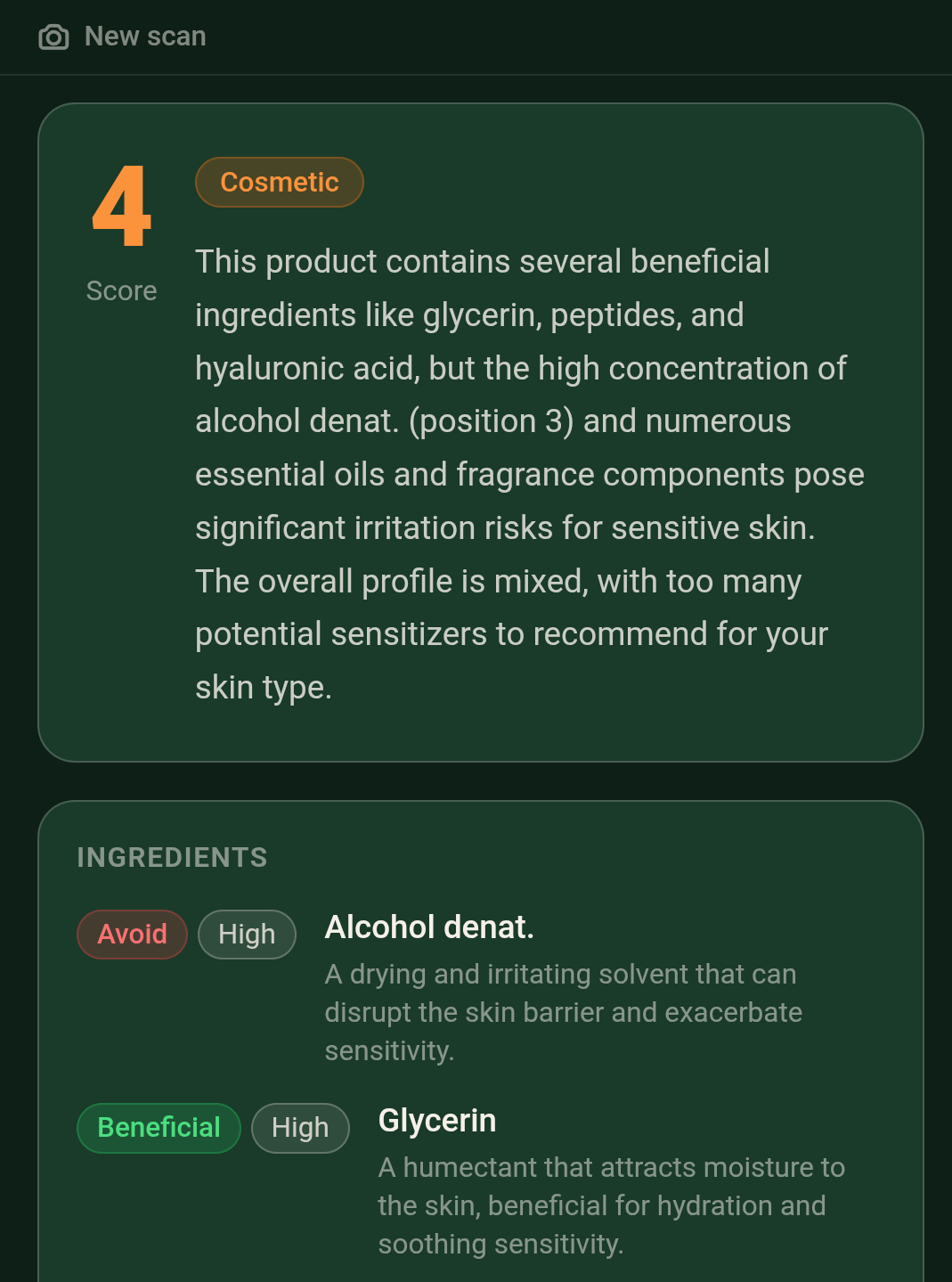
Each ingredient flagged for your skin profile — irritants in red

Check your own products in seconds
Scan a barcode or the ingredient list — Skanna tells you whether the formula is good and whether it suits your skin.
Try Skanna freeFree: 5 scans and 5 recommendations a week · Sign in with Google
Frequently asked questions about cosmetic ingredient safety
Is phenoxyethanol safe in cosmetics?
Phenoxyethanol is approved in both the EU (up to 1%) and the US as a cosmetic preservative and is considered safe for most adults. France's ANSM specifically cautioned against use on infants under 3 and on nappy-area skin. For healthy adults the risk is low — some people with very sensitive skin experience mild irritation that clears up when switching to a phenoxyethanol-free formula. It became dominant after the EU paraben restrictions, so it is now in the vast majority of water-based cosmetics.
Are parabens banned in the EU or US?
In the EU, five long-chain parabens were banned in 2014 as suspected endocrine disruptors. Methylparaben and ethylparaben remain legal at defined concentrations. In the US, the FDA has not banned any parabens, though it has been monitoring them since 2005. Many brands reformulated globally for EU compliance. A product labelled "paraben-free" is using alternative preservatives — not necessarily safer ones, just different.
How can I tell if a product contains endocrine disruptors?
There is no mandatory label. The reliable method is to read the INCI list and search for substances flagged as suspected endocrine disruptors: certain parabens, oxybenzone, triclosan, BHA (butylhydroxyanisole), and phthalates (banned in EU cosmetics but present in some imports). A skincare ingredient analyzer like Skanna automates this check against current EU regulatory classifications, saving you the manual lookup for every product.
Do silicones clog pores?
Silicones form an occlusive layer on the skin's surface but do not penetrate deeply into pores. For most skin types, this is harmless or beneficial. For acne-prone skin, some silicones may theoretically contribute to congestion, though clinical evidence is limited. It is largely an individual tolerance question rather than a proven safety concern. If you are congestion-prone, watch for cyclic silicones (Cyclopentasiloxane, Cyclohexasiloxane) high in the ingredient list rather than avoiding all silicones categorically.
Is a "natural" ingredient always safer?
No. This is one of the most common skincare misconceptions. Among the most frequent contact allergens identified by dermatologists are natural ingredients: essential oil components (Linalool, Limonene, Eugenol), propolis, natural latex, and wheat and milk proteins. Conversely, many synthetic molecules are chemically inert and extremely well-tolerated. Safety is determined by chemical identity, concentration, and individual skin profile — origin (natural vs synthetic) is not a reliable safety indicator.
Scan your skincare products for free at skanna.skin — create your skin profile in 2 minutes and get an instant personalised analysis of every product you own.
Check your own products in seconds
Scan a barcode or the ingredient list — Skanna tells you whether the formula is good and whether it suits your skin.
Try Skanna freeFree: 5 scans and 5 recommendations a week · Sign in with Google